
A Travel Guide to Guilin and Yangshuo
Home to some of the most recognizable landscapes in China, Guangxi is a region that includes the neighboring towns of Guilin and Yangshuo. This region is known for its endless karst peaks rising above lush fields and winding rivers. Beyond the scenery, you’ll find old towns dating back centuries and quiet pockets of local life—neighbors playing mahjong, fishermen along the riverbanks, and people simply going about their day. Guilin and Yangshuo offer a more raw side of China, especially when you step off the beaten path.
In early December 2025, my cousins and I visited China for the first time. We began our trip in Guilin and Yangshuo, which couldn't have been a better starting point. What stood out to me were the otherworldly karsts which were unlike anything we’d ever seen, the unexpected amount of fall foliage even in early winter, and the people who made us feel at home with their warmth and hospitality. And, of course, the delicious food!
To help plan your own visit to Guilin and Yangshuo, keep reading for our detailed guide and itinerary—and watch my YouTube video! Planning a visit to China can feel overwhelming as it can be logistically tricky (at least it was for us), so I hope this guide makes it easier for you!
If you're interested in exploring more of China, check out my blog post for a travel guide to Xijiang Village.

Table of Contents
Skip ahead to specific sections in this guide!

When to visit Guilin and Yangshuo
Below you’ll find a breakdown of what weather to generally expect during each season in Guilin and Yangshuo.
• Summer (June—August): Expect hot and humid weather. Summer is the warmest and wettest season in Guilin and Yangshuo. Be prepared for hot temperatures, high humidity, and frequent rain showers. Summer is also a busy time for domestic tourism, so expect larger crowds at popular spots.
• Fall (September—November): Expect mild days and cool nights. Autumn is considered one of the best times to visit Guilin and Yangshuo, with more comfortable temperatures making it ideal for outdoor activities and seeing the karst landscapes before the gloom of winter sets in (which can still be beautiful in its own way).
• Winter (December—February): Expect cool to chilly weather. Winter is the quietest and coldest season in Guilin and Yangshuo. It’s also the driest season—making it ideal if you want to explore without worrying about rain.
• Spring (March—May): Expect mild weather. Spring is also recommended as one of the best times to visit Guilin and Yangshuo, with comfortable temperatures and blooming flowers throughout the area. However, keep in mind that late spring marks the start of the rainy season.

Where to stay in Guilin and Yangshuo
Below you'll find recommendations on where to stay in Guilin and Yangshuo, based on our personal experience. Accommodations in these towns range from boutique hotels to luxury resorts. I recommend booking through Trip.com or Booking.com—we booked our stay through the latter, but both platforms are reliable for China travel.
• Guilin: We stayed at Secret Courtyard Resort Hotel and cannot recommend it enough. This hotel was cozy and homey, and our room was spacious with plenty of amenities. They offered daily complimentary breakfast, laundry service (they washed, dried, and folded our laundry for us), and even electric scooters to borrow. What really stood out was our host, who was incredibly accommodating and helpful throughout our stay. While I highly recommend this hotel, you can find additional accommodations in Guilin here to compare.
• Yangshuo: If we had more time, I would have loved to book an additional stay in Yangshuo. Instead, we took a day trip from Guilin via DiDi (China’s ride-hailing app). Yangshuo offers several accommodations that overlook the karst landscapes, some with views right from your room. You can find accommodations in Yangshuo here.


Getting around in Guilin and Yangshuo
Below you'll find recommendations on how to get to, from, and around Guilin and Yangshuo.
Getting to and from Guilin and Yangshuo: The main ways to travel in and out of Guilin and Yangshuo are by air or train.
• By air: We flew into Guilin Liangjiang International Airport (KWL), which is the main airport serving both Guilin and Yangshuo. From the airport, we hailed a DiDi to get to our hotel in Guilin—though taxis are also readily available.
• By train: Guilin has three train stations (Guilin Railway Station, Guilin North Railway Station, and Guilin West Railway Station), while Yangshuo has one (Yangshuo Railway Station). We departed from Guilin West Railway Station since it was closest to our hotel, and booked our train tickets through Trip.com. Tickets are typically released two weeks in advance and sell out very quickly, so be sure to book as soon as they become available.
Getting around in Guilin and Yangshuo: Below you'll find recommendations on how to get around Guilin and Yangshuo, as well as tips based on our personal experience.
• Guilin: Guilin can be explored by DiDi, taxi, bus, and bike or e-scooter rentals. Because DiDi was very affordable (especially when split between four people), we mostly relied on it during our time in Guilin. While bike and e-scooter rentals are popular, be sure to use caution in busier areas—especially if you’re not used to navigating traffic in China.
• Yangshuo: Yangshuo can be explored by DiDi, taxi, river transport, and bike or e-scooter rentals. Note that while we were able to take a DiDi from Guilin to Yangshuo, they were less frequent in Yangshuo—especially in more rural areas. At one point, there were no DiDis available so we accepted a ride from a local and paid via Alipay.

Travel tips for China
Below you'll find extra bits of information that you might want to know before your visit to China.
Are there international entry requirements that I should be aware of? As of March 2026, United States citizens need a valid passport and visa to enter China. However, entry requirements can change or vary depending on where you're traveling from—be sure to check the most up-to-date requirements here before your visit.
How do I get a visa? The process is mostly the same for all U.S. applicants, but the exact requirements might slightly vary depending on your local consulate—wherever you are, you can search online for your local consulate’s website to confirm the exact process. I got my visa through the Chinese Consulate in Los Angeles. As of March 2026, the process includes completing an online application, visiting the consulate in person to submit your completed application and passport, and returning to pick up your passport with the visa.
To expedite the entry process upon arrival in China, complete the official declaration card online before your visit. You can fill out your arrival card in advance on China’s National Immigration Administration Government Service Platform here to save time upon arrival.
What currency should I bring? For other countries, I’d typically always recommend bringing local currency. But in China, you can rely almost entirely on mobile payment. Every place (and person) from larger establishments to street vendors uses Alipay or WeChat Pay. I recommend downloading Alipay or WeChat Pay on your phone and linking your credit card beforehand—payments are made directly from your card.
How does internet work in China? This stressed me out the most before our visit, especially because I needed access to U.S.-based sites. As you might know, China has very strict internet regulations (often referred to as the "Great Firewall") which block access to sites like Google, YouTube, and more. Here’s how I stayed connected during our visit:
• Accessing blocked sites requires both an internet connection and a VPN. Internet can be via mobile data or Wi-Fi, but a VPN is needed to access blocked sites.
• I used this eSIM from Airalo that included both mobile data and VPN for my phone, which worked reliably throughout our visit. If you plan to purchase an eSIM from Airalo, you can use my referral code for $3 off your first purchase: CAROL5123.
• If you plan to use Wi-Fi on your phone or laptop, you’ll still need a separate VPN to access blocked sites. I used Mullvad VPN and LetsVPN, which were both easy to set up and use. I purchased two because it was recommended to have a backup in case one doesn’t work.
Make sure to download these apps prior to your visit. In addition to Alipay or WeChat Pay, be sure to download these apps ahead of time to make your visit smoother:
• WeChat: China's primary messaging app—similar to WhatsApp and Facebook Messenger.
• DiDi: China’s primary ride-hailing app—similar to Uber and Lyft.
• AMap: China’s primary navigation app—similar to Apple Maps and Google Maps.
• Google Translate: Download offline translations in advance, and use your phone’s camera to translate text on the go.
• Dianping: China's primary local reviews app—similar to Yelp and Google Reviews.
• Trip.com: If you booked trains or hotels through Trip.com, download the app to easily access your bookings.
Only certain power banks are allowed. If you plan to bring a power bank to China, be aware that only certain models are allowed. Power banks must meet the requirements here—otherwise, they will be confiscated at the airport (mine was).

Our 3-day itinerary in Guilin and Yangshuo
Below you'll find our 3-day itinerary for Guilin and Yangshuo. This itinerary is what worked best for our schedule and is not meant to cover all the sights in this area. Note that all of the links listed below direct to AMap (China's primary navigation app), as some locations can’t be pinpointed on Google Maps.
Day 1 (Guilin):
Lujiacun: After checking into our hotel in Guilin, we took some time to explore Lujiacun (a small neighborhood where our hotel was located) and the surrounding area. This part of town felt tucked away, and was surrounded by mountains. While the streets were quiet during our visit, we got a glimpse into everyday life: locals going about their routines, soft chatter from nearby homes and businesses, and e-scooters passing by.

Taohua Hujing Park: We walked over to Taohua Hujing Park, which was beautifully lush and green. This park features a river surrounded by trees and forested hills. We watched locals fishing and enjoying a slow pace of life.

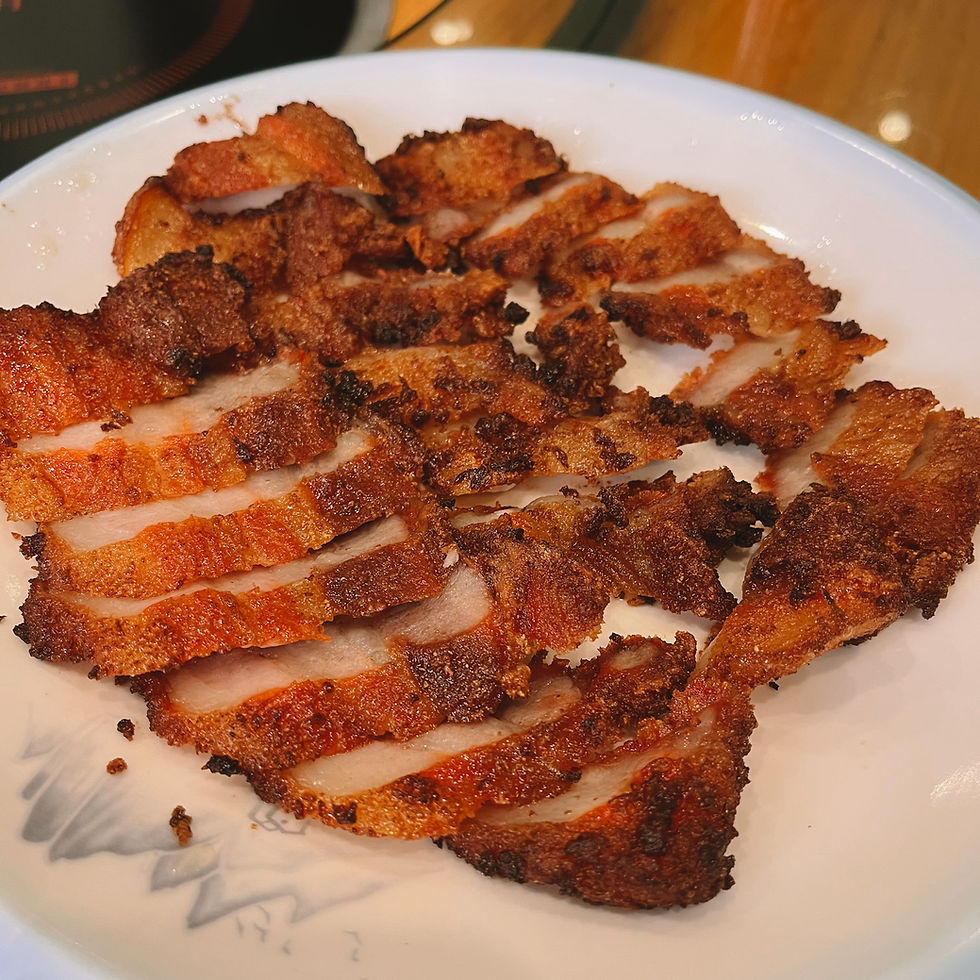
Xinyuan Farm: We had an incredible first meal at Xinyuan Farm. We shared an eggplant stir-fry, rice noodles, tofu stir-fry, and deep-fried pork. The pork was especially delicious—easily the best we'd all ever had. The total for four family-style dishes was around $5 USD per person, which was unbelievable!

Day 2 (Guilin and Yangshuo):
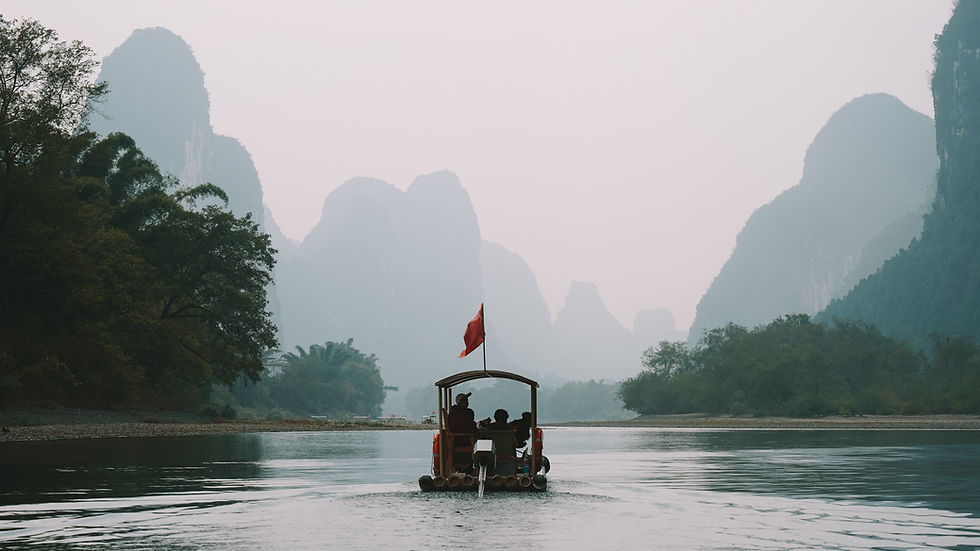
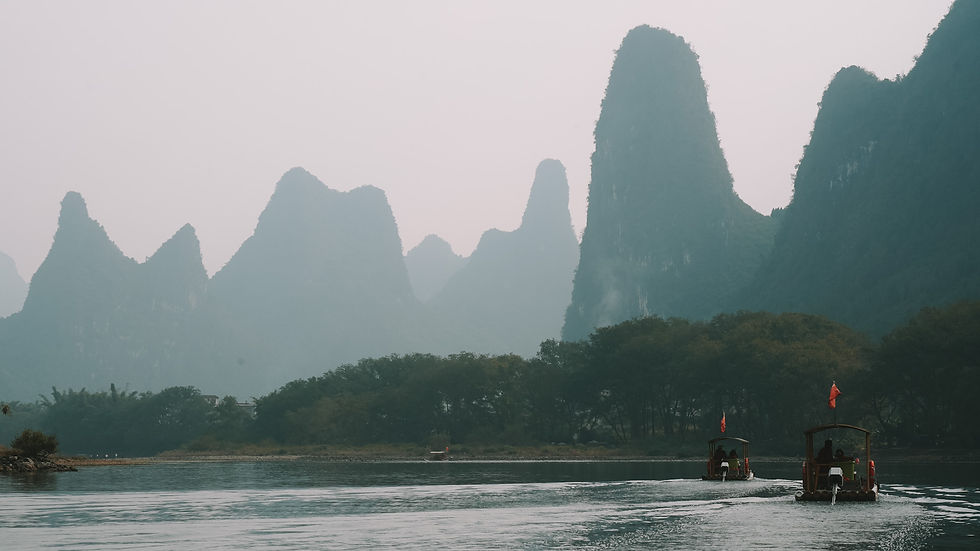
Bamboo Rafting on Lijiang River: We began the morning with a DiDi ride from Guilin to Yangshuo. As we got closer, the karsts came into view and rose dramatically from the landscape below. I had never seen anything like it—it looked and felt otherworldly.
At Yangdi Pier, we booked our bamboo raft tour directly at the ticket office. We were so glad we chose this over the standard cruise tour. We had the raft to ourselves with a guide who so clearly had a deep appreciation of this beautiful place. Being on the water made the scale of the karsts feel even more imposing. I highly recommend adding this to your itinerary.
Tickets are required and can be purchased on-site.


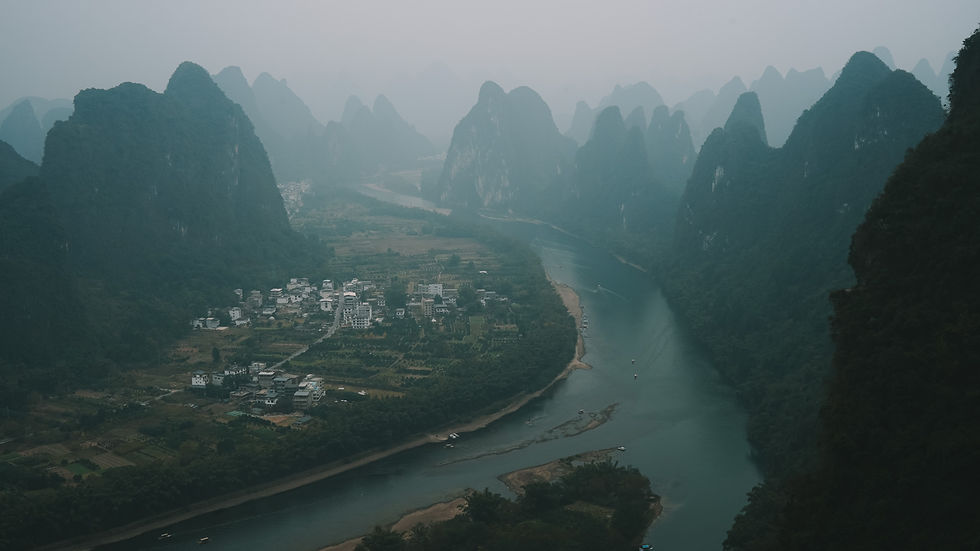
Xianggong Mountain: Xianggong Mountain offers one of the most recognizable views in Yangshuo. After walking up a series of steep staircases, you’ll reach an overlook which offers a bird’s-eye view of the Lijiang River ribboning between layers upon layers of towering karsts.
Tickets are required and can be purchased on-site.
Yujia Piaoxiang: After a half day of sightseeing, we enjoyed a late lunch at Yujia Piaoxiang. This meal was served family-style, with a selection of dishes and white rice to share. Their sweet and sour pork ribs and stir-fried vegetables were fantastic!

Daxu Ancient Town: Dating back over 1,000 years, Daxu Ancient Town feels like a step back in time. I distinctly remember the narrow stone streets winding between lantern-lined buildings. What stood out to me most was that this wasn't just a preserved historic site—people still lived here. Many doors were left open, giving us glimpses of wooden furniture in dimly lit rooms. We saw locals going about their day—some watching TV and others chatting with neighbors.
This town is a special place. It felt like scenes from a period drama, but was entirely real and lived-in.


Day 3 (Guilin):
Sun and Moon Pagodas: The Sun and Moon Pagodas sit above a lake, surrounded by lush greenery. While we visited during the day, you can also visit at night when the pagodas light up.

Elephant Trunk Hill: Elephant Trunk Hill is one of Guilin’s most popular attractions—and for good reason. A natural arch curves over the Lijiang River, resembling an elephant dipping its trunk into the water.




Comments